Introduction: The Invisible Challenge of Modern Miniaturization
In the ultra-competitive landscape of high-end laptops and mobile brand development, the engineering objective is clear: more power in less space. However, as data rates for interfaces like USB4 or Thunderbolt climb, and power densities increase, the margin for error in hardware design vanishes. A poorly placed capacitor or a mismatched impedance line can lead to catastrophic signal failure or electromagnetic interference issues.
At Chuanshang Electronics, we have spent years supporting global brand owners and ODM manufacturers. We understand that achieving peak performance requires more than just high-quality parts—it requires a strategic synergy between Integrated Circuits, Circuit Protection, and Passive Components. This guide provides a professional roadmap for optimizing your next-gen mobile hardware architecture.
1. Establishing the Signal Foundation: Integrated Circuits and High-Speed Routing
The core of any mobile device is the interaction between the processor and the peripheral Integrated Circuits (ICs). At high frequencies, every millimeter of a copper trace acts like a complex transmission line rather than a simple wire.
High-Speed Signal Integrity
To ensure data flows without reflections or crosstalk, engineers must focus on impedance matching. When integrating high-speed communication ICs:
Differential Pair Management: Ensure that traces are kept at a constant 90-ohm or 100-ohm impedance. Even a tiny physical deviation can cause a signal eye diagram to close, resulting in data loss.
Via Minimization: Every time a signal changes layers, it encounters parasitic capacitance. We recommend keeping high-speed data paths on a single reference layer whenever possible to maintain absolute signal purity.
2. Power Stability and Filtering: The Role of Passive Components
A high-performance processor is only as good as the power it receives. In mobile design, clean power is a luxury that must be engineered.
Decoupling and Power Integrity
This is where Passive Components become the unsung heroes. Using a mix of ultra-low ESR (Equivalent Series Resistance) ceramic capacitors directly next to the IC power pins is non-negotiable.
The Strategic Approach: We suggest a tiered decoupling strategy—using small-value capacitors to filter high-frequency noise and larger bulk capacitors to handle sudden current surges from the CPU. This prevents voltage droop that causes system instability during high-performance tasks.
3. Defending the Ports: Advanced Circuit Protection Strategies
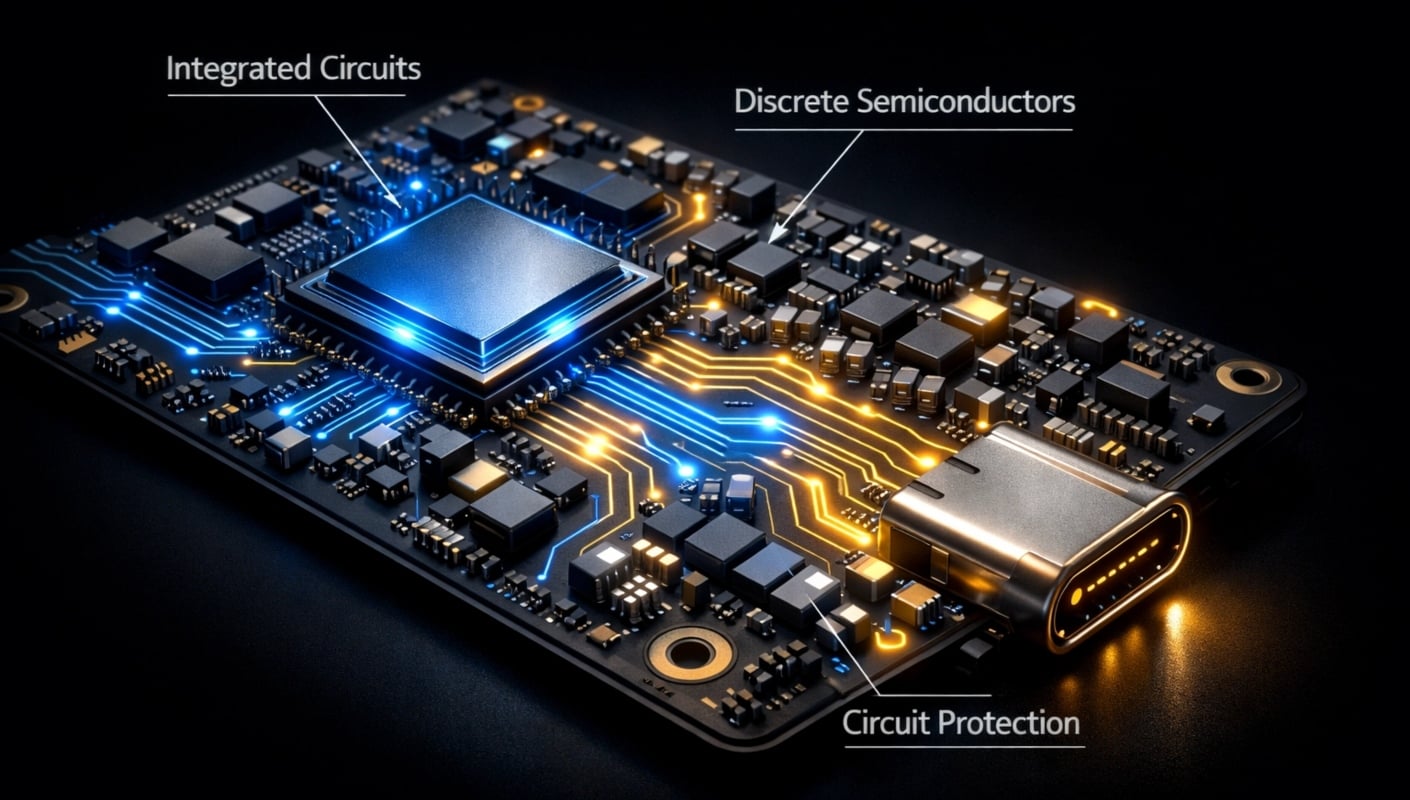
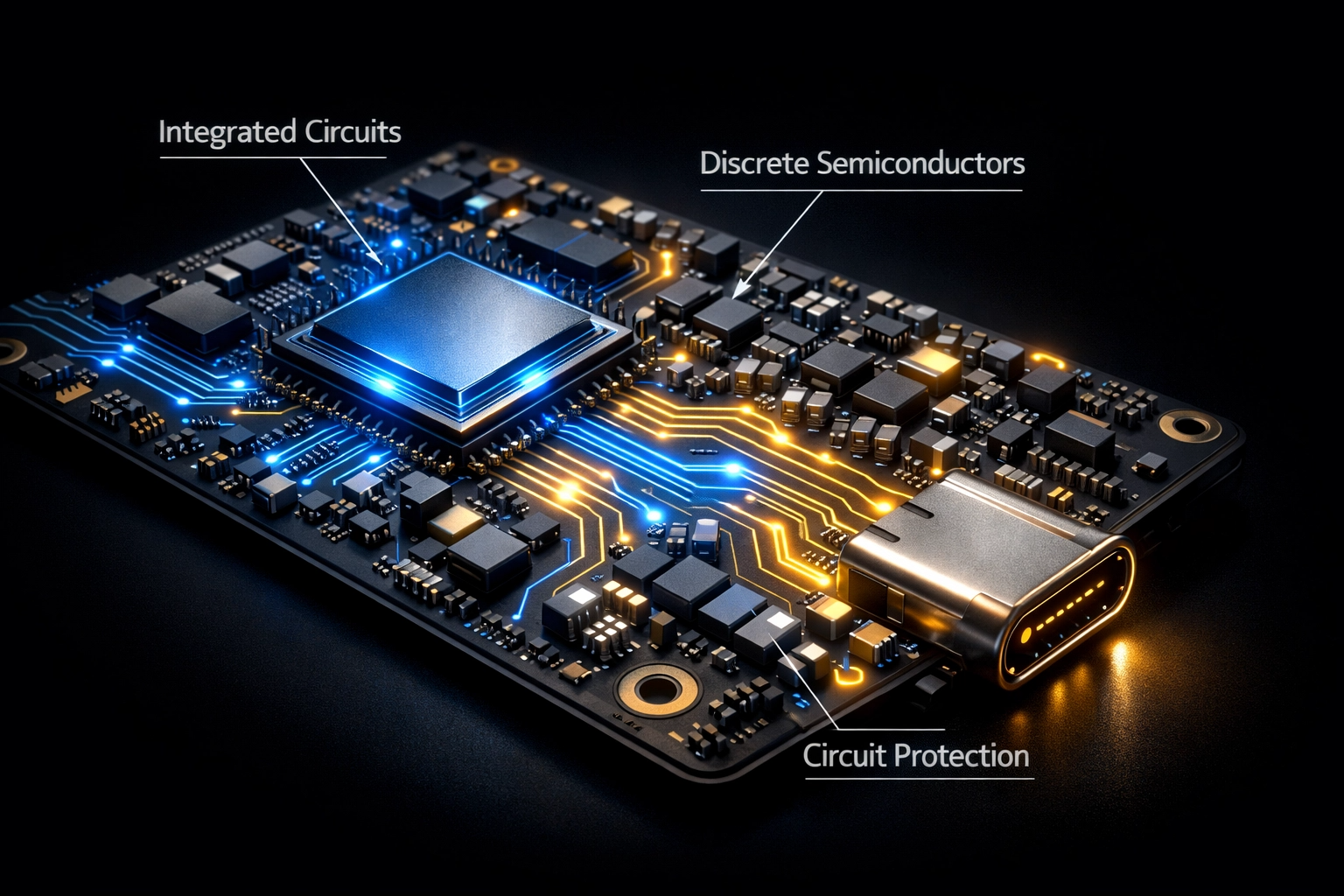
Mobile devices are constantly exposed to the human factor—specifically, Electrostatic Discharge (ESD) when a user plugs in a peripheral. Without robust Circuit Protection, a single spark can permanently destroy an expensive Integrated Circuit.
Balancing Protection and Performance
The challenge in mobile design is that protection components add capacitance, which can distort high-speed signals.
The Solution: We provide ultra-low capacitance TVS (Transient Voltage Suppressor) diodes (often below 0.2 picofarads). These are placed at the very entrance of the port (like USB-C or HDMI) to clamp the high-voltage spike to ground before it reaches the sensitive internal electronics. In our experience, placing protection components correctly on the assembly line reduces field return rates by over 30 percent.
4. Automation and Controls: Managing the Internal Environment
Modern notebooks are becoming smarter in how they manage their own health. This requires a mini-ecosystem of Automation and Controls within the device itself.
Thermal and Power Control Modules
Using specialized Industrial-grade Control ICs and Sensors, engineers can create a feedback loop for fan speed and CPU throttling.
Sensor Integration: Precision temperature Sensors must be placed near the Discrete Semiconductors (like MOSFETs) that handle the high-current charging rails. By monitoring the heat at the source, the system can adjust power delivery dynamically, preventing the chassis from becoming uncomfortably hot for the end-user.
5. Discrete Semiconductors: Efficiency in Power Delivery
Battery life is the most visible metric for mobile users. The efficiency of the power conversion—converting battery voltage to the various levels required by the ICs—depends on the quality of Discrete Semiconductors.
Minimizing Switching Losses
We focus on providing MOSFETs with low gate charge and low on-resistance. In a thin-and-light laptop, where space for heat sinks is non-existent, every milliwatt of power saved from being wasted as heat is a victory for the cooling system and the battery life.
6. The Rise of Embedded Solutions: Simplifying the Complex
As designs become more dense, the industry is moving toward Embedded Solutions. Instead of using hundreds of individual parts, engineers are integrating more functionality into sub-modules.
Modular Efficiency
Chuanshang’s Embedded Solutions help designers reduce the overall PCB footprint. By integrating signal conditioning and protection into a single module, we help manufacturers reduce assembly time and eliminate common failure points on the production line. This is particularly critical for European and North American markets where reliability is the primary driver of brand loyalty.
7. Professional Quality Assurance in Component Sourcing
From a procurement perspective, the success of a hardware design isn't just about the layout—it's about the technical integrity of the supply chain.
Why Partner with Chuanshang Electronics?
• Technical Audit: Our engineering team reviews every component against international standards before it enters our inventory.
• Full Traceability: We provide complete datasheet transparency and compliance documentation (such as RoHS and REACH) for every Passive Component and IC we distribute.
• Proven Reliability: We prioritize parts with documented longevity, ensuring that your mobile brand's reputation is built on a foundation of components that do not suffer from early life failures.
Conclusion: Bridging Concept and Reality
Optimizing a high-density mobile device is a multi-dimensional puzzle. It requires a deep understanding of how Sensors interact with ICs, how Circuit Protection shields the system, and how Discrete Semiconductors manage energy.
At Shenzhen Chuanshang Electronics, we don't just supply the puzzle pieces; we provide the engineering intelligence to help you put them together. By following these layout principles and selecting vetted components, you can ensure your next product launch is defined by its exceptional performance and unshakeable reliability.
 EN
EN